




Embedded Linux Device Driver Development
A structured learning path from Linux essentials to real-time Embedded Linux projects. The program helps learners build practical skills in Linux System Programming, Device Drivers, BSP, Yocto, Debugging, I2C drivers and project-level implementation on real hardware.
From Essentials to Industry-Ready Expertise
The course is structured into three progressive levels, so students understand the complete journey from application-level Linux to kernel, drivers, board bring-up and advanced embedded Linux domains.
Embedded Linux Foundation Engineer
Build the foundation required for Embedded Linux Device Driver Development.
Projects & Platform Development
Move into real board-level work with BSP, Yocto, debugging, I2C drivers and projects.
Embedded Linux Specialist
Specialize in selected advanced Embedded Linux areas after completing Levels 1 and 2.
LEARNER EXPERIENCES
What Our Working Professionals Say
Read feedback shared by learners who experienced the Embedded Firmware Engineer program.

Vedhavi Sapparapu
KMID: KM48AESD33-22EL
Overall, it was a great experience. The content delivered was clear and engaging, and the materials provided were very helpful. The assignments were interesting to work on and encouraged hands-on learning.
Implementing concepts on my own significantly improved my coding standards and understanding.

V. Suryateja Reddy
KMID: KM21EL25
I joined to gain practical experience to develop Device Drivers and I gained it through Kernel Masters.
Yaswanth Valicherla
KMID: KM04ALP01-21EL
Overall, I had a very good experience with Kernel Masters and Kishore sir. I would definitely recommend this course to any of my colleagues looking to improve their knowledge.
I am looking forward to receiving some good placement assistance from Kernel Masters.

Rajaram Gurunath Patkar
KM23EL06
My experience with Level 1 was good. I really want to learn Embedded Linux in-depth now, as it is very important for my career. My goal is to join top-tier companies like Qualcomm and Nvidia within the next six months.
Because of this, I expect the upcoming Level 2 and Level 3 courses to offer deep-dive training that aligns with the high requirements of these top companies.
Batch Details & Learning Requirements
Key information for learners before enrolling into the Embedded Linux training program.
Recorded concept preparation with instructor-led interactive practical sessions.
Required for better understanding of system programming and driver development.
9:00 PM – 10:30 PM IST
Recorded Videos: Tue, Thu, Sat
Students should complete Linux basics, shell scripting, system programming and driver foundation before entering Level 2.
Sat: 11:00 AM – 1:00 PM IST
Recorded Videos: Mon, Wed, Fri
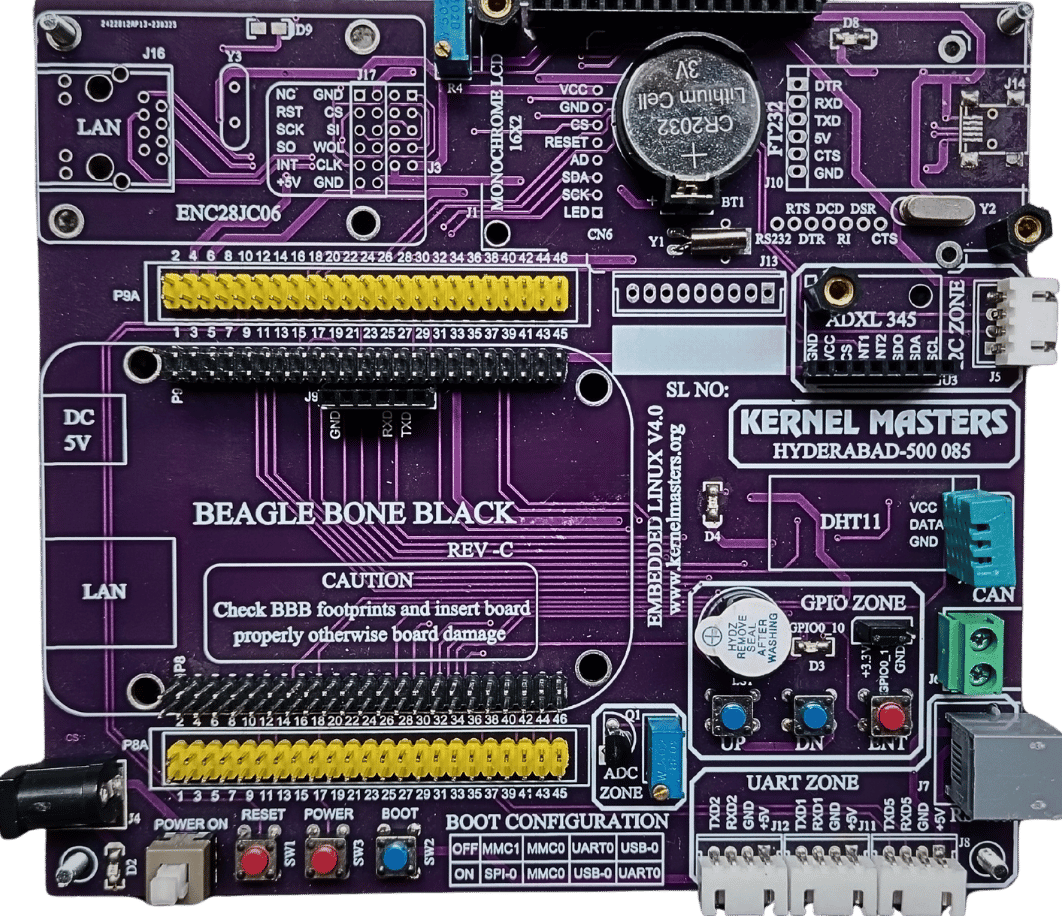
BeagleBone Black + Kernel Masters BeagleBone Black Expansion Board.
Level-wise Curriculum, Fees & Batch Details
Explore each level with curriculum details, batch schedule, syllabus links and clear module-wise fee structure.
Embedded Linux Foundation Engineer
Level 1 builds the foundation required for Embedded Linux Device Driver Development. Students learn Linux basics, shell scripting, Linux System Programming and Linux Device Driver fundamentals with practical examples.
- Linux Basics
- Shell Scripting
- Linux System Programming
- Driver Fundamentals
- Command-line Practice
- No Hardware Required
Program Name |
Duration |
Start Date |
Within India |
Outside India |
Syllabus |
|---|---|---|---|---|---|
Linux Fundamentals & Shell Scripting |
2 Weeks |
28th Sept 2026 |
FREE |
FREE |
— |
Linux System Programming |
3 Weeks |
12th Oct 2026 |
₹14,500 |
349 USD |
|
Linux Device Drivers |
3 Weeks |
2nd Nov 2026 |
₹14,500 |
349 USD |
|
Total Value |
— |
— |
₹29,000 |
698 USD |
— |
Discount |
— |
On or Before 24th Sept 2026 |
-₹11,000 |
– 200 USD |
— |
Offer Fee |
— |
— |
₹18,000 |
498 USD |
— |
Linux System Programming
- Linux architecture, GNU toolchain and OS concepts
- File operations, process management, signals and POSIX threads
- IPC, synchronization mechanisms and socket programming
- Hands-on examples such as evtest, fbtest, rtc test, i2cdev and spidev
Linux Device Drivers
- Kernel modules, character drivers and multiple device drivers
- Interrupt handling, kernel timers and kernel threads
- Character, block and network driver concepts
- Exposure to input, ALSA, V4L2, network, camera, IoT and display subsystems
Projects & Platform Development
Move into real board-level Embedded Linux development with BeagleBone Black, Kernel Masters Expansion Board, BSP, bootloader, kernel customization, device drivers, debugging and industrial project workflows.
- BeagleBone Black Practice
- KM Expansion Board
- BSP & Bootloader
- Linux Device Drivers
- Kernel Customization
- Industrial Projects

Program Name |
Duration |
Start Date |
Within India |
Outside India |
Syllabus |
|---|---|---|---|---|---|
Embedded Linux with BeagleBone Black |
2 Weeks |
29th Sept 2026 |
₹13,000 |
398 USD |
|
Yocto Project with BeagleBone Black |
1 Week |
13th Oct 2026 |
₹6,500 |
199 USD |
|
Linux Debugging Techniques & GNU Toolchain |
1 Week |
20th Oct 2026 |
₹6,500 |
199 USD |
|
Linux I2C Drivers |
1 Week |
27th Oct 2026 |
₹6,500 |
199 USD |
|
Embedded Linux Projects |
2 Weeks |
3rd Nov 2026 |
₹13,000 |
398 USD |
|
Placement Assistance Program |
Till Placement |
— |
FREE |
— |
— |
Kernel Masters BBB Expansion Board |
— |
— |
₹5,664 |
199 USD |
— |
Total Value |
— |
— |
₹51,164 |
1592 USD |
— |
Discount |
— |
On or Before 24th Sept 2026 |
-₹18,664 |
-597 USD |
— |
Final Offer Fee |
— |
— |
₹32,500 |
995 USD |
— |
Embedded Linux Porting & BSP
- Linux porting on target board, boot sequence and bootloader concepts
- Device tree source, Linux platform/bus/low-level drivers
- Build systems including Buildroot and Yocto Project
KM-BBB Expansion Board
- Practice UART, I2C, RS485, CAN, SPI, USB and ADC interfaces
- Work with 16×2 LCD, RTC, EEPROM, GPIO pins, buzzer, LEDs and potentiometer
- Designed to support real embedded Linux development practice
Yocto, I2C & Debugging
- Customize Yocto project as per board requirements
- Develop I2C drivers for RTC DS1307, EEPROM AT24C02 and ADXL345 accelerometer
- Use GDB, KGDB, KDB, strace, valgrind, kexec and crash tools
Embedded Linux Projects
- Add GPIO, UART, I2C and SPI devices
- Build project examples such as data logger, weather monitoring system and IoT gateway
- Project module eligibility depends on completion of required Level 2 modules
GST, shipping, customs or additional hardware charges may apply wherever required.
Level 3: Embedded Linux Specialist
Advanced add-on modules for learners who want deeper exposure to specialized Embedded Linux domains.
Upcoming Track
Sun: 10:00 AM – 1:00 PM IST
Program Name |
Duration |
Start Date |
Within India |
Outside India |
Syllabus |
|---|---|---|---|---|---|
Linux Network & SPI Drivers |
2 Weeks |
To be Announced |
₹6,500 |
199 USD |
To be uploaded |
Embedded Android |
2 Weeks |
To be Announced |
₹6,500 |
199 USD |
To be uploaded |
Wi-Fi Driver / Firmware |
2 Weeks |
To be Announced |
₹6,500 |
199 USD |
To be uploaded |
Industrial IoT Gateway |
2 Weeks |
To be Announced |
₹6,500 |
199 USD |
To be uploaded |
Offers & Terms
Transparent fee breakup and current offers for Level 1, Level 2 and combo enrollment.
Limited Period
Level 1 Offer
For complete Level 1 essentials track.
Level 2 Offer
Includes project track and KM-BBB Expansion Board pricing in the fee breakup.
Level 1 + Level 2
Combo offer for students enrolling for both levels together.
Terms & Conditions
- Offers are valid only before the mentioned admission deadline.
- Offers apply only on single payment of the total amount.
- Offers are not applicable for individual modules.
- Students must dedicate time for classes, assignments and lab practice.
- Hardware, shipping, GST or customs charges are applicable based on location and requirement.
- Recorded video access is provided as per the batch or module policy.
- Embedded Linux project modules begin after completion of the required foundation modules.
- Offer validity and seat availability are confirmed at the time of admission.
Tools, Boards & Technologies
The program uses a practical technology stack around Linux kernel development, board-level embedded Linux and real hardware interfaces.
Learning Methodology, Hardware Practice & Career Support
A structured training approach that combines guided concept learning, real embedded hardware practice, industrial projects, and placement preparation to help students become industry-ready Embedded Linux engineers.
Industry-Oriented Learning Methodology
A blended learning approach focused on Linux concepts, live coding, debugging, hardware interfacing, assignments, industrial projects and real-world problem-solving.
Objective
- Transform students into industry-ready Embedded Linux engineers by combining structured concept learning with extensive hands-on practical implementation.
- Follow a Blended Learning Model, where students first learn theoretical concepts through recorded sessions and then attend instructor-led interactive classes focused on live coding, debugging, hardware interfacing, assignments, industrial projects, and real-world problem-solving.
- Maximize learning outcomes through a 40% Theory & Concept Building and 60% Hands-on Practical Implementation approach.
- Provide recorded videos for concept preparation and revision, released module-wise. Each module remains accessible for a minimum of 30 days according to the course schedule.
- Encourage students to complete assigned recorded lessons before interactive practical sessions to gain maximum benefit from live implementation, technical discussions, and doubt clarification.
- Help students build strong conceptual knowledge, practical skills, debugging ability, and the technical confidence expected in the Embedded Systems industry.
Highlights
- Blended Learning Model
- 40% Theory & Concept Building
- 60% Hands-on Practical Implementation
- Recorded Sessions for Pre-Class Preparation
- 30-Day Module Video Access
- Interactive Live Coding Sessions
- Real Hardware Practice
- Assignments & Industrial Projects
- Hardware Interfacing
- Live Debugging Practice
- Real-World Problem-Solving
- Industry-Oriented Learning Approach
View Related FAQs ↓
Interactive Live Sessions Are Attendance-Based
Interactive sessions are conducted for hands-on implementation, live coding, debugging, hardware experiments, and technical discussions.
Students are expected to attend every scheduled interactive session to get the best learning outcome.
Recorded concept videos are provided for preparation and revision. Recordings of interactive live sessions are generally not part of the regular course delivery.
Structured Placement Assistance
Guided preparation to help students become technically confident and interview-ready.
Our objective is to prepare students for interviews through resume improvement, project review, mock interviews, mentoring and interview readiness assessment.
- Technical Skill Assessment
- Resume Enhancement
- LinkedIn Profile Guidance
- Project Portfolio Review
- Mock Technical Interviews
- Career Mentoring
- Interview Readiness
- Continuous Support
View Related FAQs ↓
Hardware Platform & Development Boards
Real hardware practice using BeagleBone Black and Kernel Masters expansion hardware.
Our objective is to help students gain practical Embedded Linux experience through real hardware-based application development, device drivers, kernel customization and industrial projects.
- BeagleBone Black Platform
- KM BeagleBone Expansion Board
- Real Hardware Practice
- Linux Application Development
- Device Driver Development
- Kernel, Bootloader & BSP Workflows
- Industrial Project Implementation
- Optional CAN IoT Node Kit
*BeagleBone Black board must be purchased separately. KM BeagleBone Expansion Board is included with Level 2 enrollment as per course policy.
View Related FAQs ↓
Frequently Asked Questions
Common questions about the Embedded Linux and Linux Device Driver learning path.
Who is this Embedded Linux program suitable for?
This program is suitable for students and working professionals who want to learn Embedded Linux, Linux internals, board bring-up concepts and Linux Device Driver development.
Do I need prior Linux knowledge before joining?
Basic Linux command-line familiarity is helpful. For advanced Linux Device Driver modules, strong C programming and Linux fundamentals are recommended.
Will this program include hands-on hardware practice?
Yes. The program includes hands-on lab exposure using Embedded Linux boards and practical workflows related to kernel, device tree and driver development.
What topics are covered in Linux Device Drivers?
The Linux Device Driver track covers kernel module programming, character drivers, device files, file operations, GPIO, interrupts, platform drivers and related driver development concepts.
Is this course useful for firmware and embedded software roles?
Yes. Embedded Linux and Linux Device Driver skills are useful for roles in embedded software, BSP, platform engineering, device drivers, IoT gateways and product development.
Build Practical Skills in Embedded Linux Device Drivers
Join Kernel Masters Embedded Linux Device Driver Development program and move from Linux fundamentals to board-level embedded Linux projects with structured guidance.
 Admission for 6 months Embedded AI & IoT offline course at Hyderabad & Bangalore
 Course Fee: ₹12000 /-