


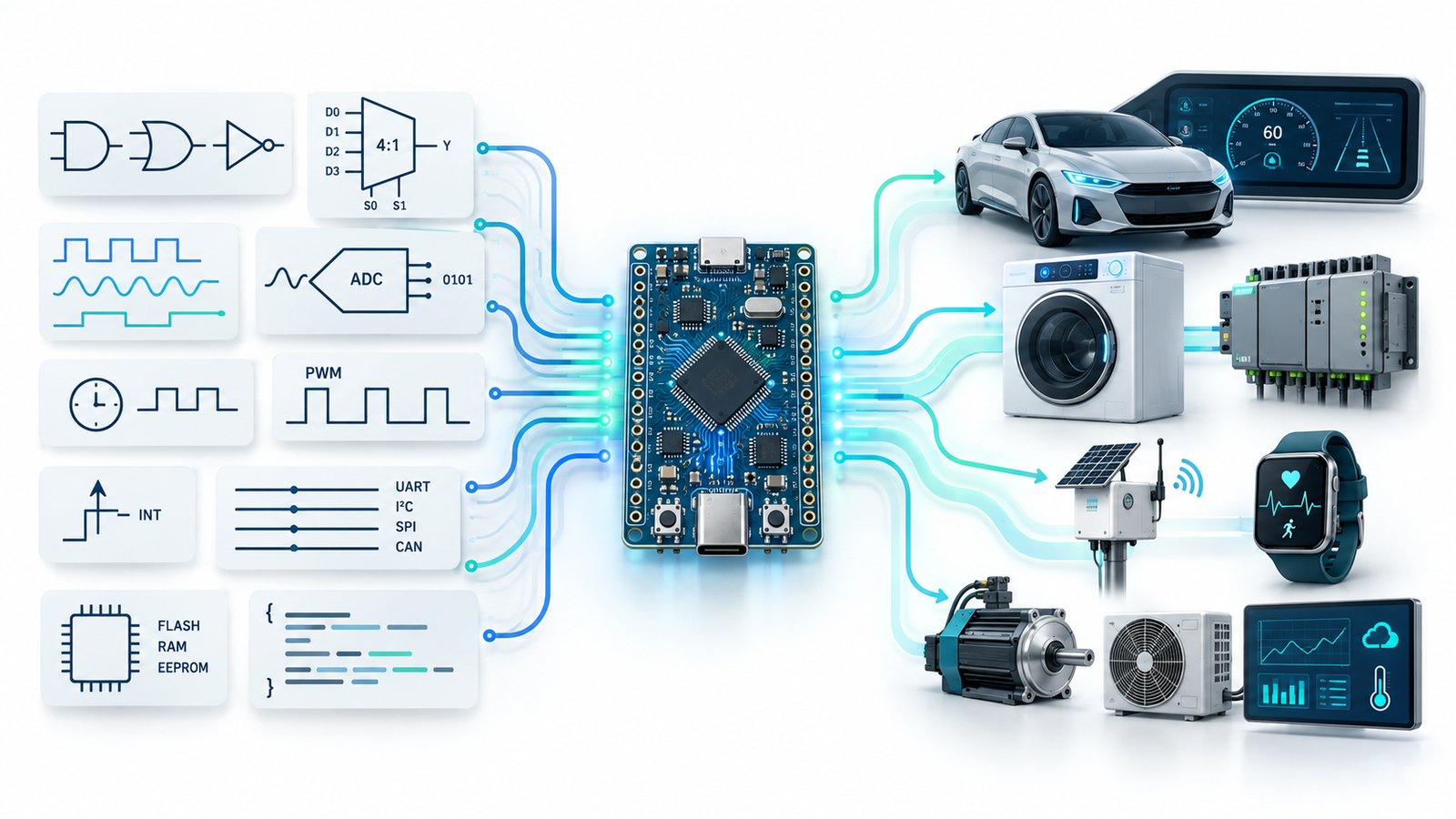
From Classroom to Industry: How Engineering Subjects Are Used in Real Embedded Products
Many Electronics students study Digital Electronics, Microprocessors, Microcontrollers, C Programming, Signals and Systems, Communication Systems and Control Systems as separate subjects.
But industry does not use them separately. A real embedded product may combine concepts from all of them at the same time.
What you will learn in Day 3
- Why engineering subjects are really useful
- Multiplexer to MCU pin multiplexing
- ADC, timers and PWM
- Interrupts and event response
- Communication protocols
- Memory, logic gates and registers
- Signals, control and Embedded AI
- Academic concept to industrial application
- Challenge, takeaways and Day 4 preview
01 · Academic to Industrial
Are Engineering Subjects Really Useful?
Students sometimes ask: “Why did we study Multiplexers?” “Where will I use ADC?” “Why do we need Timers?” “Why should I learn Signals and Systems?” “Where are Flip-Flops used?”
The problem is usually not the subject. The missing piece is the connection between academic knowledge and industrial application.
A modern embedded product may use Digital Electronics for logic and registers, microprocessor concepts for CPU and memory, C for firmware, Signals and Systems for sensor data, communication protocols for connecting devices, and Control Systems for motors and automation.
Do you know it?
Which statement is closest to reality?
02 · Multiplexer to Pin Multiplexing
Can One Microcontroller Pin Perform Different Jobs?
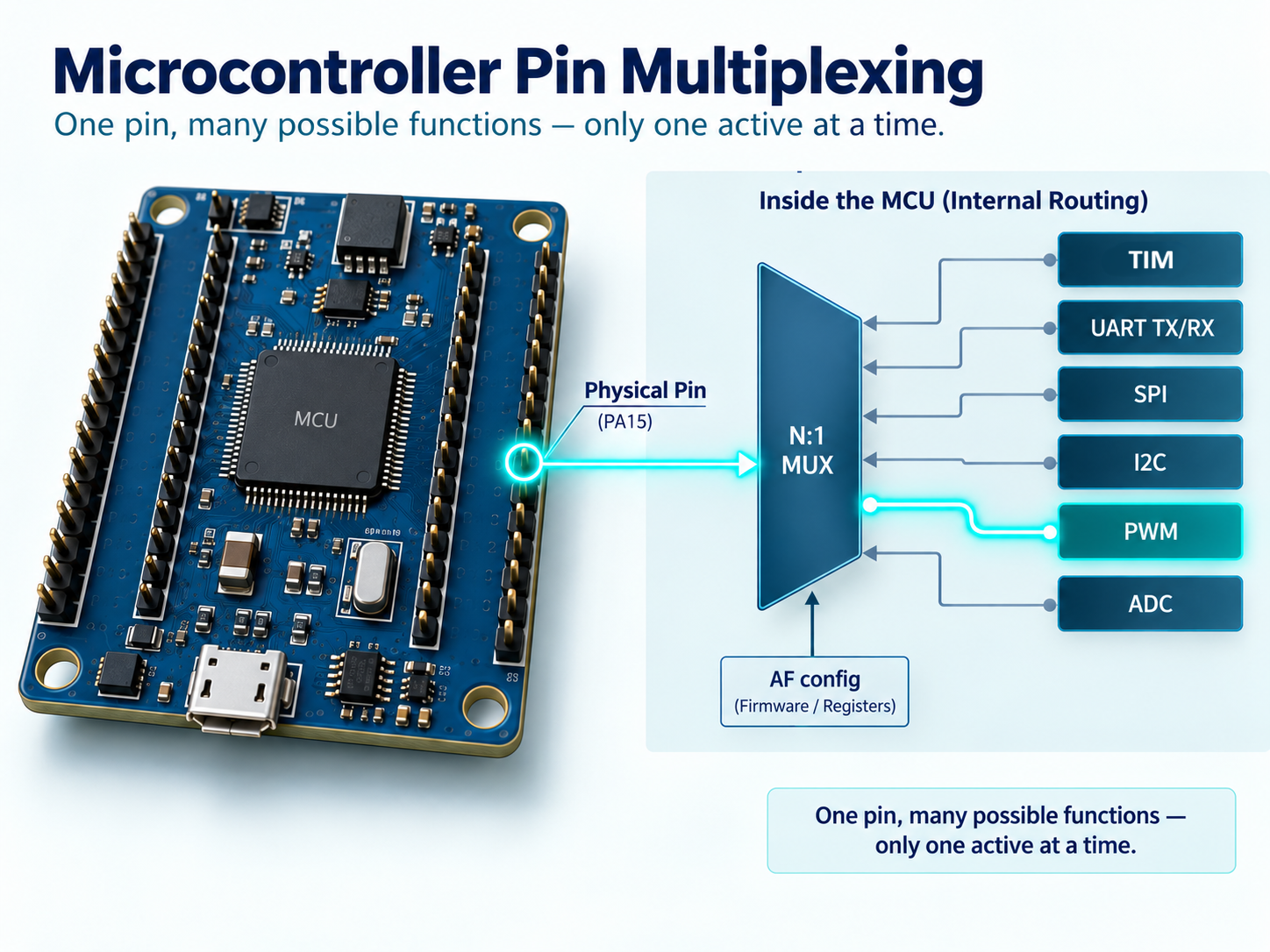
Most Electronics students learn Multiplexers in Digital Electronics. A multiplexer can be thought of as multiple inputs → selection → one output.
Now consider a modern microcontroller such as the STM32F401RBT6 Cortex-M4 used on the Kernel Masters Raayan Mini platform. The microcontroller contains GPIO, UART, I²C, SPI, timers, ADC and other functions, but the physical IC package has a limited number of pins.
Providing a separate external pin for every possible internal peripheral signal would make the device much larger and more expensive. Instead, microcontrollers use pin multiplexing.
Do you know it?
Can one physical microcontroller pin support multiple possible functions?
Why pin planning matters
This is why embedded engineers work with both datasheets and schematics, not just C code.
03 · Signals to Action
ADC, Timers and PWM: Connecting the Physical World to Software
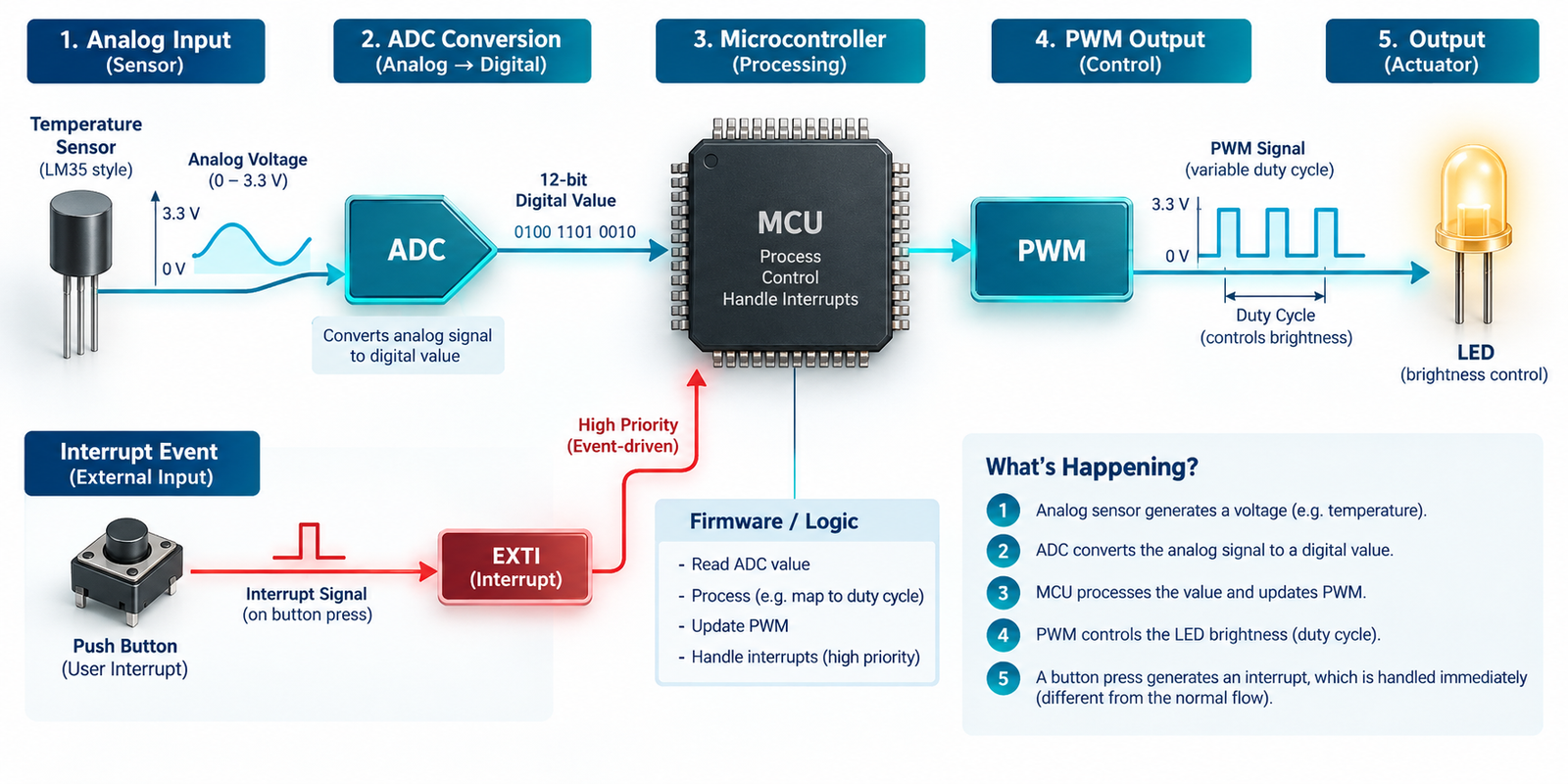
A microcontroller works with digital information. But the real world contains analog quantities such as temperature, pressure, light, battery voltage, current, sound and vibration.
ADC: Analog quantity to digital number
Suppose a temperature sensor produces an analog voltage. The CPU does not directly understand “this voltage means 32°C.” The ADC converts the analog signal into a digital code, and firmware interprets that code as an engineering value.
Do you know it?
How many possible digital codes can a 12-bit ADC represent?
Timers
A hardware timer counts clock events and generates accurate timing events. Timers are used for periodic execution, timeouts, frequency measurement, input capture, output compare, PWM generation and RTOS timing.
PWM
Pulse Width Modulation rapidly switches an output ON and OFF. The percentage of each cycle for which the signal remains ON is called duty cycle.
04 · Event Response
Interrupts: When Something Important Happens
Imagine a processor monitoring an emergency-stop button. One method is to repeatedly check: “Pressed?” “Pressed?” “Pressed?” This is called polling.
Another approach is to let the processor continue useful work. When the event occurs, the hardware informs the processor: “Something important happened!” This mechanism is called an interrupt.
The CPU temporarily handles the event and then returns to its previous work.
Do you know it?
Which mechanism is often suitable when the processor must respond quickly to an unexpected event?
Communication Protocols: How Devices Talk to Each Other
A microcontroller rarely works alone. It may communicate with sensors, memories, displays, wireless modules, other microcontrollers, automotive ECUs and industrial controllers.
| Protocol | Common applications | Beginner idea |
|---|---|---|
| UART | Debug console, GPS, Bluetooth/Wi-Fi modules and simple serial devices. | Simple serial communication between devices. |
| I²C | RTC, EEPROM, accelerometers, temperature sensors and low-speed peripherals. | Multiple devices can share SDA and SCL lines using addresses. |
| SPI | TFT displays, external Flash memories, SD cards, ADCs and high-speed sensors. | Useful for relatively fast peripheral communication. |
| CAN | Automotive ECUs and industrial control systems. | Reliable communication between controllers in demanding systems. |
CAN inside vehicles
Modern automobiles contain many Electronic Control Units such as engine ECU, ABS, airbag controller and dashboard. These controllers need a reliable communication mechanism. CAN is one of the most important protocols used in automotive embedded systems.
06 · Digital Electronics Inside Products
Memory, Logic Gates and Registers
Computer Organization and Digital Electronics become more interesting when students understand where those ideas appear inside embedded products.
Flash Memory
Typically stores program code, constants and non-volatile information. Flash retains its contents when power is removed.
RAM
Typically stores runtime variables, stack, buffers and temporary data. RAM normally loses its contents when power is removed.
Registers
Registers store processor or peripheral state and provide fast access to control information.
C Variables
Your variables eventually occupy real memory locations. This connects C programming to processor memory.
Logic gates: not just truth tables
Consider an industrial machine. It should run only when the door is closed, the start button is pressed and emergency stop is not active.
The same AND, OR and NOT concepts studied in Digital Electronics appear in real safety and control logic.
Flip-Flops → Registers → Processor
07 · Signals to Intelligence
Signals, Control Systems and Embedded AI
Embedded AI does not begin with AI. It begins with the physical world. A vibration sensor on an industrial machine collects raw signals that may contain noise, useful frequencies, transient events and mechanical signatures.
Signal processing may be used to clean, filter or extract useful information before an intelligent decision is made.
This is an example of Edge AI, where intelligence operates closer to the device instead of depending entirely on a remote cloud.
08 · Complete Mapping
Academic Concept → Industrial Application
Here is the complete connection. This is the section students should revisit whenever they feel their classroom subjects are disconnected from real products.
| Academic concept | Industrial application |
|---|---|
| Logic Gates | Safety logic and control decisions. |
| Multiplexer | MCU pin and peripheral-function selection. |
| Flip-Flops | Registers and state storage. |
| ADC | Analog sensor acquisition. |
| Timers | Precise timing. |
| PWM | Motor, fan and LED control. |
| Interrupts | Event-driven response. |
| UART / I²C / SPI / CAN | Debugging, sensors, displays, memories, automotive and industrial communication. |
| RAM / Flash | Runtime data and firmware storage. |
| Signals | Sensor processing. |
| Control Systems | Motors, robotics and automation. |
| AI | Intelligent local decision-making where applicable. |
09 · Challenge
Mini Challenge: Smart Industrial Temperature Controller
Imagine an industrial system that must measure temperature, display the value, control a cooling fan, sound an alarm if temperature becomes dangerous and send status information to another controller.
| Requirement | Embedded concept |
|---|---|
| Temperature measurement | Sensor + ADC |
| Decision making | STM32 + Firmware |
| Display | SPI or I²C depending on the display |
| Fan speed | Timer + PWM |
| Critical alarm | Firmware + output control |
| Communication | UART / CAN / another suitable interface |
Day 3 Summary
Day 3 Key Takeaways
The most important lesson from Day 3 is that your engineering subjects are not isolated academic chapters.
Day 3 Assignment: Classroom-to-Industry Challenge
Choose one engineering subject such as Digital Electronics, Microprocessors, Signals and Systems, Control Systems, Communication Systems, Electronic Devices or C Programming.
Identify three concepts from that subject and, for each concept, find one real industrial application. Try to explain your answer in 60 seconds.
Example: Digital Electronics
Multiplexer → MCU pin multiplexing
Logic Gates → Industrial safety logic
Flip-Flops → Processor registers
Final Thought
Your engineering subjects were never completely separate. The separation existed mainly in your academic timetable.
Inside a real embedded product, Digital Electronics meets C, sensors meet ADC, timers meet motors, communication meets devices, and signals meet AI.
And the Embedded Engineer connects all of them.
Kernel Masters
 Admission for 6 months Embedded AI & IoT offline course at Hyderabad & Bangalore
 Course Fee: ₹12000 /-